Welcome to VineCopulas’s documentation!
VineCopulas is a Python package that is able to:
Fit both bivariate and vine copulas
Simulate from both bivariate and vine copulas
Allow for both discrete as well as continuous input data
Draw conditional samples for any variables of interest with the use of bivariate copulas and different vine structures
Installation
pip install vinecopulas
Documentation Contents
Getting Started
Get started by testing checking out the package functionality using the Abalone example data.
import pandas as pd
import matplotlib.pyplot as plt
import numpy as np
from vinecopulas.marginals import *
from vinecopulas.bivariate import *
from vinecopulas.vinecopula import *

datapath = 'https://raw.githubusercontent.com/VU-IVM/vinecopula/develop/doc/sample_data.csv'
df = pd.read_csv(datapath)
df.head()
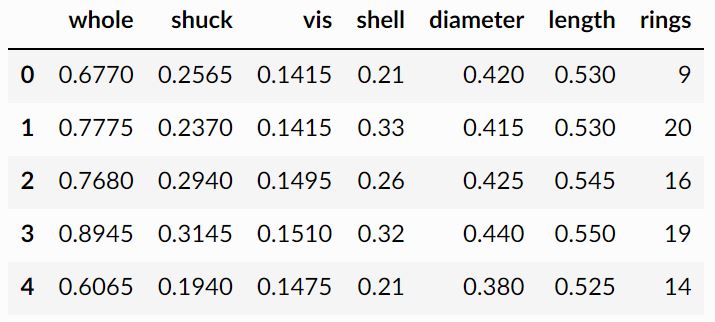
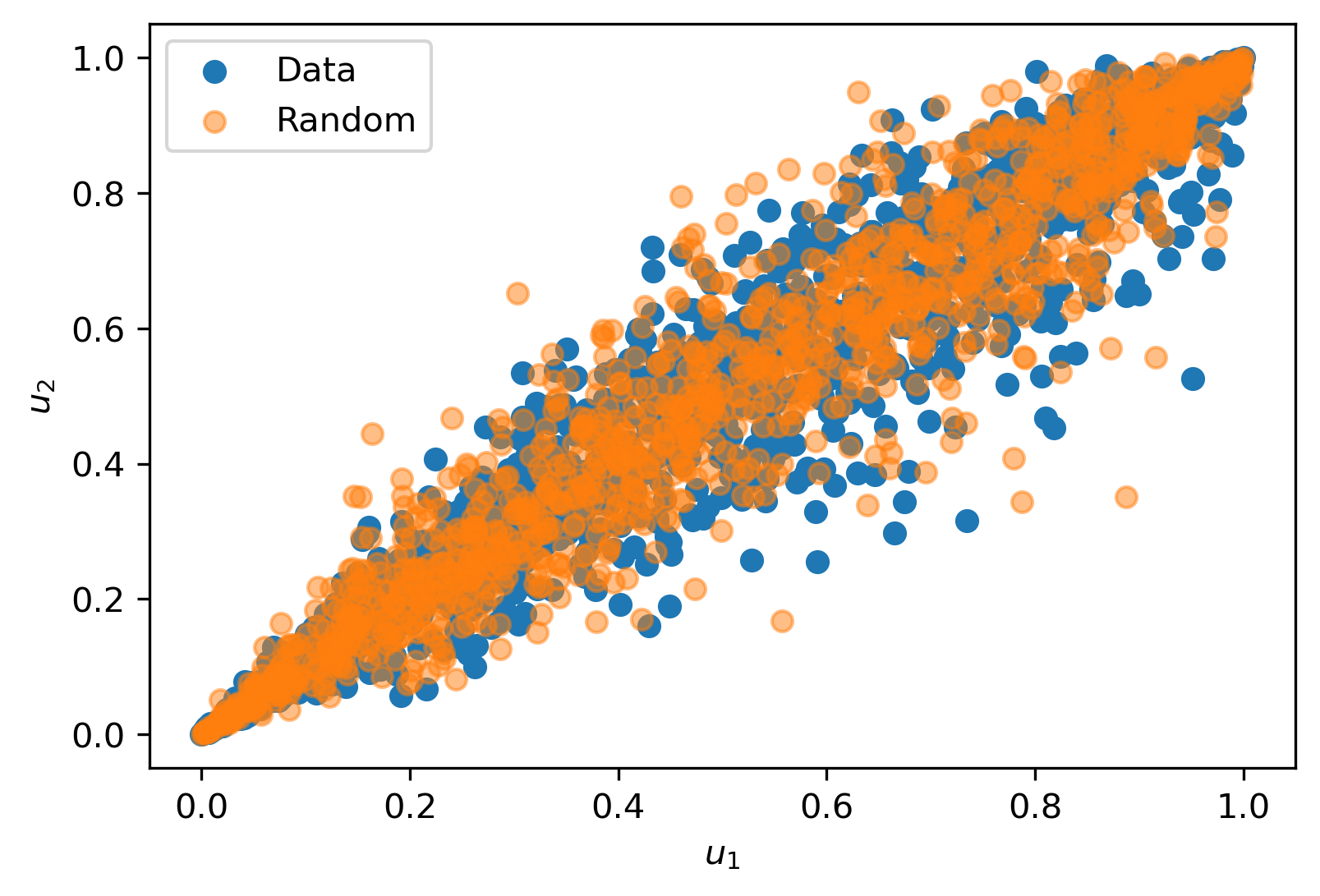
Transform the data to pseudo data and fit a survival gumbel copula between two variables. Use the fitted copula to generate random samples.
x = np.array(df)[:,:-1]
u =  pseudodata(x) # computes the pseudodata
cop = 4 # copula 4 is the gumbel copula with 180 degree rotation
par = fit(cop, u[:,:2]) # fit the variables in the first 2 columns
n = len(u) # number of samples to generate
ur = random(cop, par, n) # generate random samples
# plot
plt.scatter(u[:,0],u[:,1], label = 'Data')
plt.scatter(ur[:,0], ur[:,1], alpha = 0.5, label = 'Random')
plt.xlabel('$u_1$')
plt.ylabel('$u_2$')
plt.legend()
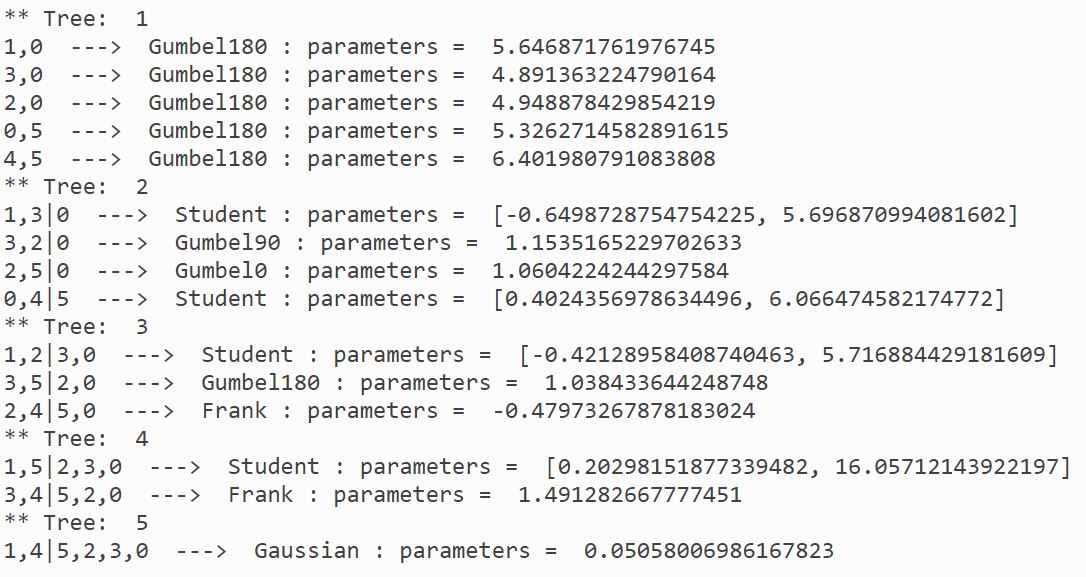
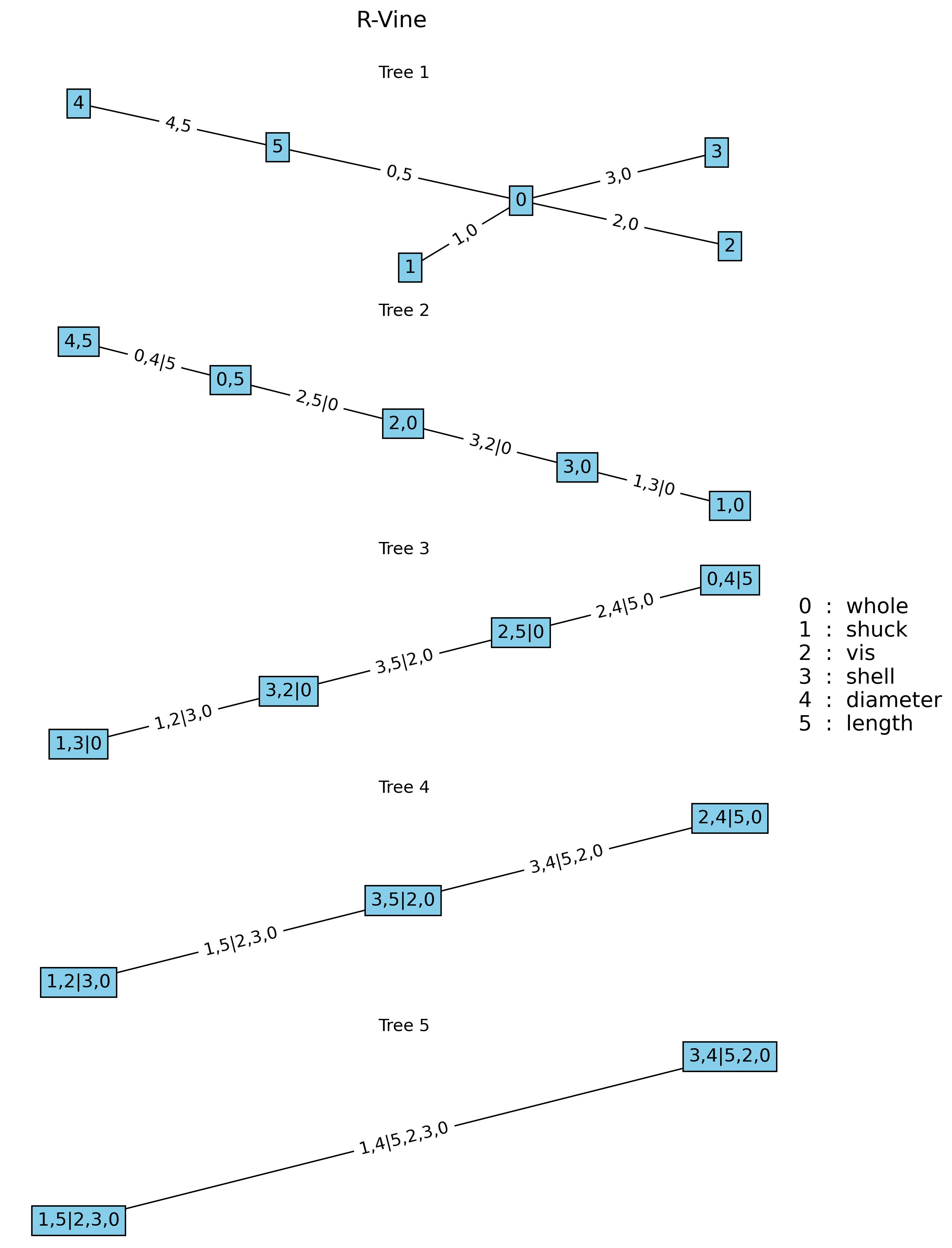
Fit a vine copula between multiple variables in the data, considering all possible copulas available in the package.
cops = list(range(1,16)) # fit vine copula according to these copulas
M, P, C = fit_vinecop(u, cops, vine = 'R') # fit R-vine
plotvine(M,variables = list(df.columns[:-1]), plottitle = 'R-Vine') # plot structure
For more examples, please have a look at the rest of the documentation.
Contribution Guidelines
Please look at our Contributing Guidelines if you are interested in contributing to this package.
Asking Questions and Reporting Issues
If you encounter any bugs or issues while using VineCopulas, please
report them by opening an issue in the GitHub repository. Be sure to
provide detailed information about the problem, such as steps to
reproduce it, including operating system and Python version.
If you have any suggestions for improvements, or questions, please also raise an issue.
Citing the Package
If you use the VineCopulas package in your work, please cite:
Claassen, J. N., Koks, E. E., de Ruiter, M. C., Ward, P. J., & Jäger, W. S. (2024). VineCopulas: an open-source Python package for vine copula modelling. Journal of Open Source Software, 9(101), 6728. https://doi.org/10.21105/joss.06728